TRAIN, EQUIP, TRANSFORM : INVESTMENTS THAT PREPARE THE HEALTH OF TOMORROW
Beyond
medicines and prevention campaigns, the fight against HIV and tuberculosis has
helped to build a more lasting legacy: a more competent, better equipped and
more resilient health system.
In
the Republic of Congo, investments made thanks to international financing,
particularly those from the Global Fund implemented with the support of UNDP,
have left gains that will continue to produce their effects for many years,
directly improving the well-being of populations, particularly those in
situations of economic vulnerability.
FOCUS ON SKILLS TO
STRENGTHEN SUSTAINABLY THE HEALTH SYSTEM
The greatest asset of a health system remains its
human capital. Training healthcare professionals, program managers, and
community stakeholders is an investment in a resource that will continue to
generate benefits long after funding ends. Between 2023 and 2024, 80
professionals received specialized training in monitoring and evaluation and
project management. These professionals now lead health programs using their
own performance monitoring tools.
This skills development gradually reduces dependence
on international technical assistance and promotes the emergence of national
expertise capable of passing on its knowledge to future generations.
Capacity building also extended to health human
resources and communities. Between 2024 and 2025, a total of 3,554 people were
trained on HIV, tuberculosis, human rights, and community monitoring, 67% of
whom were women. It would be helpful, however, to specify the breakdown of
these beneficiaries by professional category, indicating whether they were
doctors, nurses, biologists, pharmacists, laboratory technicians, community
health workers, or other professionals. Distributed across the country's
fifteen departments, these professionals and community actors now play a vital
role as intermediaries between the population and health services. They direct
people to testing, promote treatment adherence, strengthen prevention
activities, and help reduce the stigma surrounding HIV and tuberculosis.
Through a spillover effect, the skills acquired will continue to benefit tens
of thousands of people in the coming years.
Improving the quality of care also involved
infection prevention. Between 2024 and 2025, 1,499 healthcare workers were
trained in infection prevention and control practices. Beyond the management of
HIV and tuberculosis, these skills enhance patient safety across all healthcare
facilities. Each trained professional then becomes a potential trainer for
their colleagues, promoting the gradual dissemination of best practices
throughout the healthcare system. The acquired skills remain available to
address other health priorities in the country. Concurrently, three specialized
experts were deployed to the National HIV Program, the National Tuberculosis
Program, and the national laboratory network. The objective was not to replace
national teams, but to provide coaching, with a view to the sustainable
transfer of skills and strengthening the country's technical autonomy.
Thus, between 2023 and
2024, 80 professionals benefited from specialized training in monitoring and
evaluation and project management..
INFRASTRUCTURES THAT BENEFITALL HEALTH PROGRAMS
The investments made are not limited to human
resources. They also include infrastructure that will continue to serve the
needs of HIV and tuberculosis control programs well beyond the current focus on
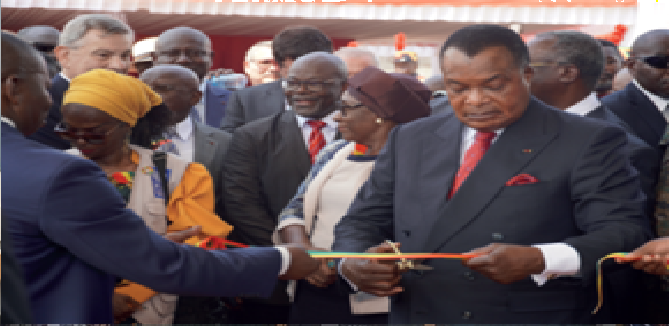
these areas. The construction in 2024 of a warehouse at the Central Purchasing
Agency for Essential Medicines (CAMEPS) is a prime example. This building,
which meets international health standards, covers an area of 700 m², with a
storage volume of nearly 3,500 m³, effectively halving the existing national
storage capacity. The newly constructed facility comprises a warehouse, a cold
storage room, and a technical room.
This facility was designed as a smart tool, adhering
to environmental standards and offering functionality with a reduced carbon
footprint, partially powered by renewable energy. This new storage capacity
sustainably improves the availability of essential medicines, vaccines, and
healthcare products, thereby reducing the risk of supply disruptions across the
country.
The construction in 2024
of a warehouse at the Central Purchasing Agency for Essential Medicines
(CAMEPS) is an emblematic example.
In addition, as part of the availability of products
to the last mile, 30 district warehouses were rehabilitated and/or built in all
departments of the country between 2023 and 2026.
These logistics platforms now facilitate the
distribution of medicines to even the most remote areas. The benefits extend
far beyond the programs funded by the Global Fund and also encompass the fight
against malaria, maternal and child health, immunization, and the management of
chronic diseases. The technical infrastructure for biomedical waste management
and infection prevention and control has also been strengthened with the
installation of 12 incinerators distributed across seven (7) departments, as
well as the provision of refrigerated trucks for transporting samples and
waste. This equipment allows for the safe disposal of biomedical waste,
reducing the risk of contamination for healthcare workers, patients, and local
communities.
Their lifespan, estimated at over fifteen years,
guarantees a lasting impact on the quality of care. It should be noted that the
availability of a biomedical waste incinerator is one of the criteria used to
determine hospital classification.
Another major advance is the modernization of the
supply chain for medicines and consumables through the gradual deployment of an
integrated management system (IMS). Ultimately, this tool will allow for
real-time monitoring of medicine and health product stocks, improving the
transparency, traceability, and responsiveness of the entire distribution
system.
The strengthening of diagnostic capacities is also a
major achievement. The construction of the National P3-level Mycobacteriology
Laboratory and the operationalization of the national mapping of GeneXpert
platforms (46 in total) have significantly improved the diagnosis of
tuberculosis, HIV/AIDS, viral hepatitis, MPOX, and Ebola virus disease. This
equipment now represents a strategic asset for the surveillance of other
emerging infectious diseases, thus strengthening the country's preparedness for
future health crises. Finally, the acquisition and provision to the Congolese
Ministry of Health and Population of eight (8) all-terrain vehicles and a
logistics truck has improved the capacity for supervising and distributing
health products. This increased mobility facilitates support for rural health
facilities and ensures better access to medicines in the most isolated
communities.
Improvements in storage and transport systems and
computer equipment promoting the digitization of health data have largely
contributed to the modernization of health infrastructure and equipment,
enabling them to respond more effectively to many pathologies other than HIV
and tuberculosis.
A LEGACY THAT TRANSCENDS PROGRAMMES FINANCES
All of these investments illustrate a major shift in
the approach to health development. Beyond responding to emergencies, they
contribute to building a more robust and resilient health system, capable of
sustainably meeting the needs of populations and ensuring its long-term
viability. The infrastructure will remain operational for many years, trained
professionals will continue to pass on their skills, while organizational
innovations will progressively strengthen health governance.
Thus, the benefits of these investments will go far
beyond the scope of HIV and tuberculosis control programs to contribute, in the
long term, to the improvement of health care and services in the fifteen
departments of the Republic of Congo.
Investments in the national response to HIV and
tuberculosis have not only saved lives; they have also strengthened the
foundations of the health system. By developing the skills of professionals,
modernizing infrastructure, strengthening governance, and mobilizing
communities, funding has created sustainable capacities that will benefit the
entire population and enable a better response to health challenges. This
vision fully illustrates the ambition of UNDP and its partners: to make every
investment in a disease a catalyst for transformation across the entire health
system.
Furthermore, as part of
ensuring the availability of products at the last mile, 30 district warehouses
were rehabilitated and/or built across all departments of the country between
2023 and 2026.
Long-term
projection: 5,053 trained healthcare professionals – what human capital builds
today protects tomorrow
The 3,554
people trained, the 1,499 health workers certified in infection prevention, and
the 80 project managers trained: this generation of professionals trained
through these grants will work for 20 to 30 years in the Congolese health
system. Each of them will train, supervise, and influence other professionals.
Projection :
If each trained professional influences 5 others in their career, more than
25,000 health workers will indirectly benefit from these training investments
by 2040. This translates into millions of better quality consultations in all
departments of Congo — a health added value that far exceeds the cost of
initial training.
Similarly,
the infrastructure built—warehouses, laboratories, incinerators—has a lifespan
of 15 to 25 years. It will serve patients who are not yet born. That is what
investment in human development is all about.build today what will protect
future generations.
No comments for the moment