THE LUMUMBA PHENOMENON: THE MAN OF THE 2025 AFCON
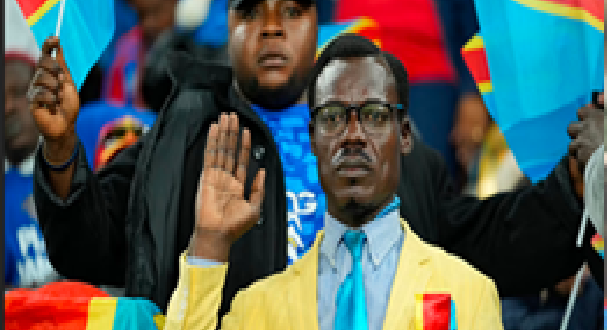
According to
several sports media outlets, the Congolese Football Federation (FECOFA) has
reportedly decided to include the famous Congolese supporter nicknamed
"Lumumba" in the official delegation that will travel to North
America for the 2026 World Cup
WHEN THE SILENCE OF THE 2025 AFCON TAKES PLACE FOR
THE 2026 WORLD CUP
According to several
sports media outlets, the Congolese Football Federation (FECOFA) has reportedly
decided to include the famous Congolese supporter nicknamed "Lumumba"
in the official delegation that will travel to North America for the 2026 World
Cup.
This measure would be
accompanied by the Congolese football governing body fully covering his
participation: visa procedures for the United States, transportation costs,
accommodation, food, and other logistical expenses would be entirely covered to
allow him to follow the national team in the best possible conditions.
According to these same
reports, this initiative follows approval at the highest level of government,
after the President of the Democratic Republic of Congo, Félix Tshisekedi,
reportedly agreed to a request made by the players themselves, who wanted this
iconic supporter to accompany the Leopards during the World Cup finals.
In this context, The
Democratic Republic of Congo would thus see a new form of symbolic representation
emerge around its national team, where the figure of the supporter becomes, in
turn, a full-fledged actor in the global adventure.
THE CAN : A SPACE OF SENSORY
OVERLOAD
Far from statistics and
scoreboards, understanding what transpired in the stands of the 2025 Africa Cup
of Nations required first closing your eyes and listening. The Africa Cup of
Nations was a matter of perpetual motion.
The stands had become a
constantly undulating human ocean. They breathed, swayed, and vibrated under
the influence of thousands of bodies and voices united in a single, unified
experience. Drums, chants, flags, cries of joy or anger: African football had
been a total, immersive, almost organic experience.
But this collective
intensity also had a downside. It imposed a constant overstimulation, both for
the players and the fans. In this environment saturated with sounds, images,
and emotions, body and mind were pushed to their limits.
THE EMERGENCE OF SILENCE: A
VISUAL AND MENTAL BREAK
In the perfectly
orchestrated tumult of the 2025 Africa Cup of Nations, a disconcerting image
emerges: that of a man standing still, silent. Michel Kuka Mboladinga doesn't
sing, doesn't dance, doesn't react. Not to the goals, not to the referee's
decisions, not to the collective euphoria. His presence, both imposing and
calm, creates a fixed point in a world designed for movement. Where everything
is in turmoil, he embodies restraint. Where everything is shouting, he imposes
silence. This posture acts almost as a collective mental pause, a form of
stability at the heart of the excitement.
A CONTROLLED PERFORMANCE, NOT
A COINCIDENCE
What is striking about
Lumumba VEA is not only the strangeness of the gesture, but its absolute
consistency. Match after match, without lapse, without fail. This is neither
improvised folklore nor a media stunt. It is a deliberate, rehearsed, and
self-conscious performance. Scarlet yellow suit, neatly knotted tie, upright
posture, arm raised to the sky, palm open: nothing is left to chance.
This posture faithfully
reproduces that of the statue of Patrice Lumumba erected in Kinshasa, a major
figure in Congolese and Pan-African history. But beyond the historical
reference, this prolonged immobility demands considerable physical and mental
discipline: muscle control, fatigue management, and mastery of emotional
impulses. All these skills are directly linked to the mechanisms of mental
health.
SILENCE, CONCENTRATION AND
MENTAL HEALTH
In the field of health,
silence is not an absence. It is often a therapeutic tool. Meditation,
mindfulness, breathing techniques, or visualization: all rely on the ability to
refocus despite external agitation. The posture of
Lumumba VEA dramatically
illustrates this ability. In the midst of a noisy and stressful environment, he
manages to maintain an apparent state of calm and inner stability. This
contrast sends a powerful message: it is possible to remain present without
being overwhelmed by emotional overload. For young fans, often exposed to
social pressure, hyperconnectivity, and constant excitement, this image becomes
a powerful metaphor for managing stress and emotions.
The
Lumumba phenomenon goes beyond football. It speaks of memory, dignity, but also
of collective mental health.
MEMORY, IDENTITY AND PSYCHOLOGICAL
BALANCE
By adopting Patrice
Lumumba's stance, Michel Kuka Mboladinga goes beyond mere historical homage. He
inscribes collective memory within a popular space: the stadium. He reminds us
that identity, when embraced and internalized, can become a source of psychological
stability.
Social sciences and
psychology demonstrate that a sense of belonging, the continuity of memory, and
the recognition of roots play a key role in the mental well-being of
individuals and communities. Here, memory is not shouted, it is embodied.
WHEN SPORT BECOMES A SYMBOLIC
CARE SPACE
At the 2025 Africa Cup of
Nations, Lumumba VEA didn't touch a ball. Yet, he made a lasting impression. In
a tournament dominated by movement, his stillness became a message. In a world
saturated with noise, his silence resonated. It reminds us that sport is not
just about performance and adrenaline, but also a space for symbols,
transmission, and emotional regulation. His immobility invites us to rethink
how we experience major sporting events: no longer simply as emotional
releases, but also as potential moments for reflection, grounding, and balance.
The Lumumba phenomenon transcends football.
It speaks of memory,
dignity, and collective mental health. At the 2025 Africa Cup of Nations, his
silence was not an emptiness. It was a language. A reminder that, sometimes, in
the clamor of the world, standing straight and still is already an act of inner
resistance and care.
WHEN SPORT BECOMES A MENTAL
HEALTH SPACE
Sport is often associated
with physical performance, endurance, and muscular prowess. Yet, modern health
now recognizes a crucial truth: sport is also a major arena for mental health.
In an environment of
sensory overstimulation like a stadium—intense noise, emotional pressure,
collective excitement—Lumumba VEA's stillness acts as a striking counterpoint.
His immobility evokes practices known in psychosomatic medicine: mindfulness,
meditation in a stable posture, and emotional regulation through silence.
According to several studies in sport
psychology, the ability to remain calm in a stressful environment is associated
with better anxiety management, a reduction in cortisol (the stress hormone),
and increased emotional stability. Unwittingly, Lumumba VEA illustrates a
fundamental principle of mental health: calmness is a physiological strength.
SILENCE AS AN RESPONSE COLLECTIVE
STRESS THERAPY
In modern societies, and
particularly in contexts marked by colonial history, conflict, and inequality,
stress is not merely individual. It is collective, historical, and
transgenerational. By embodying
Patrice Emery Lumumba, a
major figure in the Congolese struggle for independence, Lumumba VEA revives a
still painful memory. The mental health of people also depends on their ability
to name, acknowledge, and symbolize their traumas. Specialists speak of
unresolved collective traumas, responsible for: social anxiety disorders,
latent aggression, loss of identity markers, and a chronic sense of injustice.
Football, the
quintessential popular sport, becomes an unexpected therapeutic space where
memory finds peaceful expression. Lumumba VEA's silence acts as a form of
collective catharsis, allowing historical pain to be transformed into shared
dignity.
POSTURE, BODY AND
PSYCHOSOMATIC HEALTH
Lumumba VEA's posture is
not insignificant. Standing still, with a fixed gaze and outstretched hand, his
body becomes a message. In psychosomatic health, posture directly influences
breathing, heart rate, self-perception, confidence, and self-esteem.
Medically recognized
disciplines such as yoga, tai chi, and standing meditation demonstrate that
controlled stillness improves cardiovascular and mental health, particularly in
individuals exposed to chronic stress. In this sense, Lumumba VEA reminds us
that the body is not merely an instrument of performance, but also a tool for
psychological resilience and inner stability.
A HEALTHY SUPPORT FOR HEALTH ATHLETE
MENTALITY
The mental health of
athletes has become a major issue in modern sport. Depression, performance
anxiety, burnout, and sleep disorders are affecting a growing number of
professional players. In contrast to aggressive cheering or the pressure of the
stands, the silent and respectful support embodied by Lumumba VEA offers an
alternative model. It reminds us that: encouraging does not mean oppressing,
supporting does not mean demanding, and loving sport can also be an act of
kindness. This type of presence helps create a healthier emotional environment,
beneficial for both players and fans.
In
the field of health, silence is not an absence. It is often a therapeutic tool.
WHEN THE ICON BECOMES VULNERABLE: THE
MENTAL HEALTH OF PUBLIC FIGURES
The frenzy surrounding
Lumumba VEA quickly overwhelmed the man himself. Constant demands, media
overexposure, and symbolic expectations: all these factors can undermine his
mental well-being. Medicine now recognizes that sudden notoriety, even
positive, is a significant source of stress. It can lead to anxiety, loss of
control over one's image, and emotional exhaustion. The presence of a manager,
a communications officer, and a security team around Lumumba VEA serves as a
reminder of an often-ignored reality: the mental health of symbols is also a
matter of public health.
BEYOND FOOTBALL: HEALING
BODIES AND MEMORIES
At the 2025 Africa Cup of
Nations, Lumumba VEA didn't score a single goal. Yet, his impact is profound.
He reminds us that health is not merely the absence of disease, but encompasses
mental balance, collective memory, bodily dignity, and respect for oneself and
others. His stillness is a message of health: in a noisy world, learning to
stand in silence is sometimes a therapeutic act. Sport heals when it respects
the body, soothes the mind, and honors memory. Lumumba VEA reminds us that the
most lasting victory is that of mental balance and human dignity.
No comments for the moment