MADAME ADAMA-DIAN BARRY, UNDP RESIDENT REPRESENTATIVE IN THE REPUBLIC OF THE CONGO
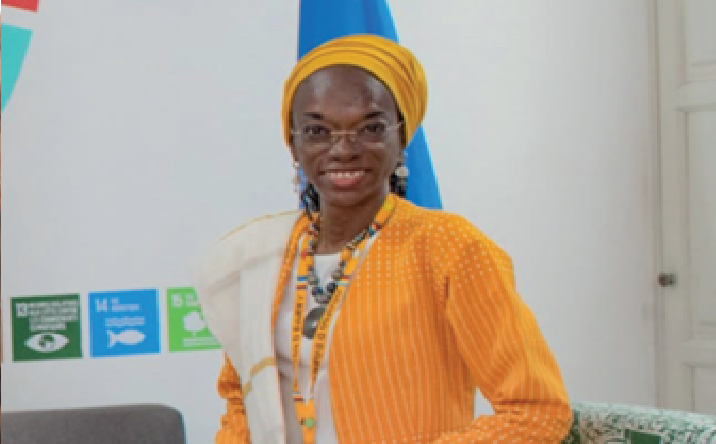
At
the helm of the United Nations Development Programme (UNDP) in the Republic of
Congo since 2023, Ms. Adama-Dian Barry leads the institution's interventions in
strategic areas such as health, governance, climate, youth employment and
sustainable development.
Drawing on her extensive experience within the United Nations system in more than twenty countries, she supports the Congolese authorities in implementing national priorities and the Sustainable Development Goals (SDGs).
In this interview with LE METROPOLIS magazine, the Resident Representative discusses the progress made in strengthening the Congolese health system, the results achieved through the partnership between the Government, UNDP, and the Global Fund, as well as the challenges related to declining international funding. She also addresses the new approaches promoted by UNDP to foster more inclusive development based on the green economy, climate resilience, gender equality, youth empowerment, and more sustainable financing for public policies. Interview.
Interview by Jérôme Batungassana
THE METROPOLIS:
Madam Resident Representative, your career has led you to hold high-level positions in several countries before your appointment to the Republic of Congo. How does this international experience influence your approach to development, and what priorities have you set since taking up your post in Congo?
MADAME ADAMADIAN BARRY :
Thank you very much for reminding me of my career path, which undoubtedly led the UNDP to choose me to represent the institution in the Republic of Congo. For me, it is a true privilege to serve, because working at the UNDP means serving humanity, serving humankind. This is first and foremost a personal conviction. The role of the UNDP in the Republic of Congo is to support the implementation of the Government's priorities in order to create well-being for all Congolese people, wherever they may be in the country. Upon my arrival in July 2023, one of the first major steps was supporting the UNDP in organizing the Three Basins Summit on Biodiversity Ecosystems and Tropical Forests, which was held in Brazzaville.
The Three Basins Summit was held from October 26 to 28, 2023, in Brazzaville. It brought together stakeholders to unite the three major ecological lungs of the planet: the Amazon, the Congo Basin, and the Borneo-Mekong-Southeast Asia region [Editor's note]. It was an important moment for sustainable human development in a country with exceptional natural resources like the Congo.
The Congo Basin is considered one of the world's largest ecological reserves. The challenge, therefore, is to enable the countries concerned to sustainably transform this natural capital into a genuine driver of prosperity and development, particularly through the ecological transition and mechanisms such as carbon
markets. The issue of health is also inextricably linked to this preservation of natural capital. When the environment degrades, the risks of natural
disasters increase, as do the health threats associated with the emergence of new diseases. The Congo is among the countries particularly vulnerable to the
effects of climate change.
Subsequently, within the framework of the Sustainable Development Goals Summit organized on the sidelines of the United Nations General Assembly, UNDP supported the Republic of Congo in identifying three major priorities: reducing inequalities, building resilient cities and communities, and promoting sustainable economic growth.
I also had the honor of accompanying the UNDP Regional Director for Africa to a meeting with His Excellency Mr. Denis Sassou-N'Guesso, President of the Republic, who reaffirmed his commitment to accelerating the achievement of well-being for all Congolese people. It is in support of this vision that UNDP has assisted the Government and local authorities in identifying the priority needs of the population across the 90 districts of the Republic of Congo. This assessment enabled the Government, with UNDP support, to implement the Accelerated Community Development Program (ACDP), which aims to accelerate development across all regions through the construction of infrastructure and the establishment of socioeconomic facilities in essential sectors such as health, education, access to drinking water, energy, agriculture, and entrepreneurship.
This program is fully in line with the implementation of the societal project of His Excellency Mr. Denis Sassou-N'Guesso, President of the Republic, Head of State, by placing the well-being of the population at the heart of public action.
The
role of UNDP in the Republic of Congo is to support the achievement of the
Government's priorities in order to create well-being for all Congolese people,
wherever they are in the territory.
Today, our watchword at UNDP in the Republic of Congo is clear: to actively support the Government in achieving comprehensive well-being for all Congolese people, in Brazzaville as well as in Pointe-Noire, Impfondo, Épéna, Sibiti and everywhere else in the national territory.
After more than three years at the head of UNDP in the Republic of Congo, what is your view on the progress made by the country in public health, and what do you think are the main challenges that remain to be addressed?
Today, in the Republic of Congo, the health and well-being of the population represents almost 80% of the UNDP's program footprint. This shows the great importance we attach to this sector.
Last year, over 265,000 people directly benefited from the health services deployed by the Government, particularly through national programs supported by UNDP. Of these beneficiaries, 60% were women. More than 3,500 healthcare professionals also directly benefited from our interventions. Beyond these figures, the real impact is even greater.
When UNDP installs a dozen biomedical waste incinerators in several hospitals across the country, provides state-of-the-art diagnostic and laboratory equipment, or strengthens the capacity of midwives to ensure safer childbirth and prevent the transmission of diseases such as HIV/AIDS, the indirect beneficiaries are countless. Every day, thousands of patients benefit from this infrastructure and equipment, the effects of which are long-lasting. This is how UNDP's impact on the health sector is tangible.
More specifically, at the request of the Government, UNDP is currently the primary recipient of the grant awarded by the Global Fund to the Republic of Congo. Within the framework of this partnership, which mobilizes significant financial resources, and under the leadership of the Ministry of Health, UNDP supports national authorities in the effective implementation of these resources to maximize their impact for the benefit of the population. Through this intervention, we contribute to strengthening and modernizing the national health system, while facilitating access to care, treatment, and health services, particularly for the most
vulnerable populations, in the various health regions and districts of the country. All these actions are fully aligned with the priorities defined by the Ministry of Health within the framework of the National Health Development Plan (PNDS).
Do you think that, based on the results obtained on the ground, you are meeting this challenge?
I am convinced of it. But it would also be interesting to have your perspective as a journalist, given your close contact with the realities on the ground. For my part, this conviction is based on the results and impact of the national programs we support.
I am thinking in particular of the National AIDS Control Program (PNLS), the National Tuberculosis Control Program (PNLT), GRAND FORMAT, the National Public Health Laboratory, and the Central Purchasing Agency for Medicines and Health Products. These are key players in the Congolese health system.
After several years of sustained investment, we are pleased to see that these programs are gradually strengthening their capacity to meet the needs of the population. Progress is evident in improved access to care, increased treatment coverage, a decrease in infections from certain diseases, and a better quality of care.
I will give you a concrete example. A few days ago, I visited the PNLT. In discussions with the director and his teams, who were finalizing their annual report, he told me that in 2024, nearly 6,375 deaths related to tuberculosis had been avoided, meaning that many lives were saved thanks to the joint efforts of the Government and its partners.
Today,
our watchword at UNDP in the Republic of Congo is clear: to actively support
the Government in achieving comprehensive well-being for all Congolese people,
in Brazzaville as well as in Pointe-Noire, Impfondo, Épéna, Sibiti and
everywhere else in the national territory.
Furthermore, the Congo is currently making progress in the management of multidrug-resistant tuberculosis, the most serious form of the disease. Thanks to improved screening and better treatment, more patients are recovering before the disease progresses to resistant forms. These results demonstrate that the programs are having a tangible impact on the ground. They are contributing to a lasting improvement in the health of the Congolese people and the quality of their care.
The 26th International AIDS Conference, held in Rio de Janeiro under the theme "Rethink, Rebuild, Recover," highlighted major advances in prevention, treatment, and research, in a context marked by declining international funding. What impact might this new situation have on the fight against HIV in Congo-Brazzaville,
and how does UNDP intend to support the country in preserving these gains and accelerating progress?
This issue relates more broadly to the financing of health services and, beyond that, to development financing. Today, at UNDP, as throughout the United Nations system, we encourage an approach based on co-financing and national development financing.
This trend is evident in several regions of the world, particularly in Latin America, where governments and the private sector are now playing an increasingly important role in development financing. Many African countries are now following a similar trajectory, with several having achieved middle-income status.
This evolution is the result of decades of efforts to build more resilient systems, particularly in the health sector. At the same time, external financing and grants are tending to decrease, as illustrated by recent reductions in some international aid programs. Faced with this new reality, the most sustainable response lies in
greater mobilization of domestic resources. States must plan their investments, define clear priorities, and direct their budgets toward the most strategic
sectors in order to accelerate progress toward the Sustainable Development Goals, especially in the health sector.
In this regard, I would like to commend the Republic of Congo for its commitment, which in December 2025 mobilized nearly €6.4 million as its national contribution within the framework of its partnership with the Global Fund. This effort sends a strong signal and is fully in line with the co-financing dynamic that we encourage. UNDP will continue to support the Government in this transition towards more sustainable financing of health policies. We also call on the private sector to play a more active role in financing development. It is essential to establish innovative mechanisms to ensure the sustainability of health services, while guaranteeing equitable access to care. In this context, Universal Health Coverage (UHC), implemented in the Republic of Congo, is an important lever for improving social protection and facilitating access to care, particularly for the most vulnerable populations. Ultimately, the challenge is to diversify funding
sources by strengthening the contribution of the State, the private sector and national solidarity mechanisms, in order to preserve the gains in the fight
against HIV and to continue the progress made.
If we return to the issue of financing, the Director General of Africa CDC, Dr. Jean Kaseya, calls on African countries to strengthen their autonomy in health financing. Do you think African countries have the means to meet this challenge?
I am very optimistic.
Last May, Brazzaville hosted the Annual Meetings of the African Development Bank. On this occasion, the African Development Fund received a historic replenishment of its resources, thanks to contributions from several countries, some of which were participating for the first time. This is a strong signal demonstrating a growing willingness among African countries to take greater ownership of their development. Furthermore, we observe that funding continues to be mobilized to address the pandemics that are particularly affecting Central Africa.
This shows that international solidarity remains important, but that it must now be accompanied by an increased mobilization of national resources. African states are aware of the challenges and, it should be remembered, they have always been the primary funders of their own development.
They are the ones who ensure the functioning of public administrations, pay healthcare staff and cover the operating costs of infrastructure and equipment, including when these are provided by technical and financial partners.
National budgets therefore remain the most sustainable foundation for development financing. I am convinced that Africa is ready to meet this challenge.
The Republic of Congo has provided an example of this by strengthening its national contribution to health financing. At the same time, the private sector is gradually becoming more aware of its role through increasingly ambitious corporate social responsibility policies, health programs for its employees, and a growing commitment to development. Public-private partnerships are also developing in the health sector. It is by combining the efforts of governments, the private sector, and development partners that Africa will be able to build more resilient, self-reliant, and sustainable health systems.
You mentioned the strategic role of the Congo Basin, the second largest tropical rainforest on the planet and one of the world's major carbon sinks. Given that health is now central to sustainable development, how does UNDP integrate climate, gender equality, and youth engagement into its programs in the Republic of Congo?
Our program in the Republic of Congo is multisectoral and supports the National Development Plan, which aims to create greater prosperity, particularly by reducing youth unemployment. Our priority is to offer young people more opportunities by focusing primarily on two areas: employability and entrepreneurship. Regarding employment, we support the government in implementing the Stagy program, which facilitates access to internships for recent graduates and promotes their professional integration. The initial pilot phases have already yielded encouraging results, with several participants securing employment after their internships.
Our ambition is now to make it a true benchmark platform, bringing together training institutions, businesses, and young people to better align skills with the needs of the job market. We also support the Integrated Multisectoral Entrepreneurship Support Program (PROMISE), which aims to create 50,000 SMEs by 2030, half of which will be led by women.
This program supports young entrepreneurs at every stage of their journey, from project development to accessing financing and markets, particularly those offered by the AfCFTA (African Continental Free Trade Area). The environmental dimension is also central to our work. UNDP supports the Congo in implementing its decarbonization strategy, promoting the green, blue, and circular economy, and preserving the exceptional biodiversity of the Congo Basin.
In the health sector, this commitment translates in particular into improved management of biomedical waste in order to reduce the environmental footprint of healthcare facilities. At the same time, we support the energy transition through the Rural Electrification Program (PESOR), which aims to provide nearly two million Congolese people with access to electricity.
We also support the Accelerated Community Development Programme, which strengthens infrastructure and local health services. For UNDP, climate, gender equality, youth engagement, and health are not separate priorities. They are complementary dimensions that form the foundation of sustainable, inclusive, and resilient development for the benefit of the Congolese people.
As 2026 draws to a close, what are UNDP's priorities for 2030?
Our 2022-2026 cooperation cycle is coming to an end. We are already preparing, with the government, the private sector and our technical and financial partners, the next cycle 2027-2031.
This will be fully aligned with the priorities of the future National Development Plan and the Congo 2063 Vision. UNDP's role is not to define a country's priorities; it supports those set by the State by providing its expertise and innovative capacity to accelerate their implementation. In the health sector, significant progress has already been made: strengthening the skills of healthcare personnel, improving infrastructure and equipment, and supporting the development of public
policies, notably the new National Pharmaceutical Policy.
For the coming years, one of our priorities will be to accelerate the digitalization of the healthcare system. We have already begun this transformation with the implementation of a digital logistics management system for medicines, which optimizes inventory management, reduces losses, and improves the efficiency of public procurement. We also intend to strengthen e-health and telemedicine to bring healthcare closer to the population, including in the most remote areas. The
operationalization of the multimedia room at the Edith-Lucie Bongo General Hospital in Oyo is an important step in this direction. It will pave the way
for teleconsultations, exchanges between specialists, and the development of distance medical training.
In parallel, we will continue to strengthen primary healthcare by building basic health centers staffed with qualified personnel, appropriate equipment, and essential medicines, to ensure accessible healthcare services as close as possible to the people. Our ambition is clear: to ensure that every Congolese person, wherever they live, has access to modern, high-quality, and connected healthcare services. This vision of healthcare that is accessible to the last mile, more inclusive, more equitable, and more resilient will guide UNDP's work up to 2030.
Finally, Madam Resident Representative, what message would you like to send to decision-makers, the population and partners on the future of UNDP interventions in the field of health in the Republic of Congo?
My first message is one of gratitude. I would like to thank the Government of the Republic of Congo for the trust it places in UNDP and for the quality of our partnership.
I also wish to acknowledge the commitment of our technical and financial partners, particularly the Global Fund, as well as that of the Congolese private sector, especially Unicongo, UNOC, and the Congolese Postal Bank, which contribute to the implementation of concrete projects benefiting the population. The results we are seeing today are the fruit of this cooperation and the leadership of the national authorities, particularly in the health sector. It is this spirit of partnership that we must preserve and strengthen, especially given the international context marked by a decrease in certain sources of development funding. We remain confident, however. This period calls for innovation and the mobilization of new financing mechanisms.
Beyond financial resources, UNDP is bringing to the Congo its technical expertise, project management experience, and capacity to accelerate the implementation of public policies in order to produce a tangible impact on people's lives. I therefore invite all stakeholders—government authorities, the private sector, development partners, foundations, and civil society—to continue and strengthen this collective momentum. Every contribution counts.
Together, we can build a more efficient, resilient, and equitable healthcare system for the benefit of all Congolese people, especially young people. Finally, I would like to address a special message to the media.
You are essential partners.
Through your ability to inform, raise awareness, and mobilize public opinion, you play a crucial role in advocating for sustainable development and health. We are counting on you to carry these messages and support this shared ambition.
No comments for the moment