IN PARIS, CONGO EXTENDS A HAND TO ITS DIASPORA
CONSTANT-SERGE BOUNDA LAUNCHES A UNPRECEDENTED DIALOGUE TO MAKE CONGOLESE ABROAD ACTORS IN NATIONAL DEVELOPMENT
In
Paris, the Congolese government is opening a new chapter in its relations with
its diaspora. By bringing together entrepreneurs, healthcare professionals,
researchers, academics, and representatives of community organizations around
the Minister of Foreign Affairs, Constant-Serge Bounda, Brazzaville is
demonstrating a clear ambition: to make Congolese citizens abroad full partners
in national development. This meeting, focused on listening, expectations, and
investment prospects, underscores the government's commitment to building a
diplomacy based on competence, dialogue, and trust.
WHEN BRAZZAVILLE LENDS A HAND TO HIS TALENTS OF THE STRANGER
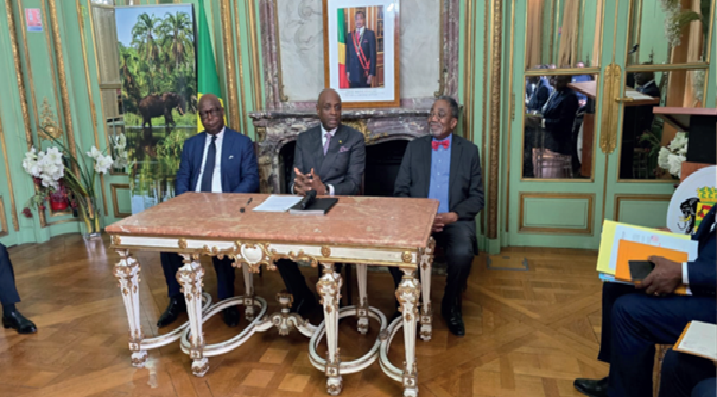
In the Green Room of the Embassy of the Republic of
Congo in Paris, the room is packed.
Entrepreneurs, doctors, researchers, academics,
students, community leaders, and former elite athletes all come together there,
driven by a shared aspiration: to be more involved in shaping the future of
their country. The lively and sometimes passionate discussions demonstrate the
deep attachment that Congolese people living in France continue to feel for the
Republic of Congo.
For several hours, members of the diaspora engaged
in open dialogue with the Minister of Foreign Affairs, Francophonie, and
Congolese Abroad, Constant-Serge Bounda. Marked by listening, accessibility,
and consultation, this meeting illustrates the Congolese authorities' firm
commitment to strengthening ties between the state and its citizens living
abroad.
After the welcome address delivered by His
Excellency the Ambassador of the Republic of Congo to France, the minister
immediately set the tone.
Keen to foster direct dialogue, he first wanted to
get to know each participant personally and invited everyone to a roundtable
discussion. This gesture was appreciated. Then, in a thoughtful move that did
not go unnoticed, he asked members of his staff to give up their seats to the
Congolese who had arrived last. This mark of courtesy and consideration was
welcomed by everyone present, who saw it as a symbol of a commitment to placing
Congolese living abroad at the heart of the discussions. Beyond the formal
nature of the meeting, Brazzaville's message was unequivocal: the diaspora is
now considered a strategic partner in national development. The authorities
intend to move beyond a relationship long focused solely on consular missions
to build lasting cooperation based on skills development, encouraging
investment, transferring expertise, and actively involving Congolese living
abroad in major public development policies.
Beyond the protocol aspect of the meeting, the message
from Brazzaville is unequivocal: the diaspora is now considered a strategic
partner in national development.
A DIASPORA AT THE HEART OF THE
NATIONAL STRATEGY
From the outset, Constant-Serge Bounda set the tone.
Addressing an attentive audience, he reminded them that Congolese people living
abroad are no longer just an expatriate community, but a strategic resource for
the country.“The Congolese diaspora represents a national asset. Through its
skills, expertise, and investment capacity, it is destined to play a decisive
role.” in the development of our country.This speech marks a shift
in how public authorities now view relations with Congolese citizens abroad.
The objective is no longer solely to fulfill traditional consular duties, but
to build a lasting partnership capable of supporting the country's
modernization. For the minister, this new dynamic rests on three essential
principles: trust, listening, and consultation.
For many participants, this
meeting represents a positive sign.
FRANK EXCHANGES ON THE CONCERNS
OF THE DIASPORA
The floor was quickly given to the participants. The
interventions followed one another in a constructive atmosphere. The concerns
were numerous: delays in issuing administrative documents, improvement of
consular services, protection of nationals, simplification of administrative
procedures, recognition of diplomas, support for investors, and the creation of
bridges between diaspora experts and public administrations.
The healthcare professionals present emphasized the
potential for medical cooperation, continuing education, and technology
transfer to Congolese hospitals. Entrepreneurs, for their part, advocated for a
more favorable investment environment and improved security for economic
projects. The minister responded to each of these concerns with a commitment to
ongoing dialogue.
« Our ambition is to build a relationship of trust
with all Congolese people living abroad. They are ambassadors for our country
and essential partners for attracting investment, developing innovation, and
strengthening scientific, economic, and cultural exchanges. ».
A DIASPORA THAT WANTS TO PASS OF THE
INTENTION TO ACTION
For many participants, this meeting is a positive
sign. Financial transfers from the diaspora already represent a significant
contribution to the Congolese economy. However, many believe their contribution
could be even more substantial if institutional mechanisms were put in place to
support their initiatives.
Throughout the discussions, one message kept
recurring: Congolese people abroad want to be involved in public policies, not
as mere observers, but as true partners in development.
« We now expect the announced commitments to
translate into concrete actions. This consultation must become permanent.», a representative of the association confided after
the meeting.
MOBILIZED PERSONALITIES AROUND
DIALOGUE
The meeting brought together several figures from
the Congolese community, including Henri Ossebi, Firmin Édouard Matoko, Driss
Senda, Gaston Nitou Samba, Innocente Félicité Sathoud, as well as former
internationals Prince Oniangué and Delvin Ndinga.
French political figures also participated in the
discussions, including Nadège Abomangoli, Vice-President of the French National
Assembly and President of the France-Republic of Congo Friendship Group; Farida
Amrani, Member of Parliament for Essonne; and Ferréol Gassackys, Member of
Parliament and member of the Committee on Foreign Affairs and Congolese Abroad.
Their presence underscored the importance placed on dialogue between French
institutions and the Congolese community.
EXCHANGES INANYWHERE NEARBY
After the plenary session, protocol gives way to a
more confidential exercise. The minister meets with several compatriots
individually. Each participant has a few minutes to present their project,
their difficulties, or their expectations. These direct exchanges allow for the
discussion of personal situations, but also for the gathering of concrete
proposals that could inform future reforms for the benefit of the diaspora.
STRENGTHENING THE AXIS BRAZZAVILLE
PARIS
The minister's visit to Paris was not limited to
exchanges with the diaspora. On Tuesday, June 30, 2026, Constant-Serge Bounda
met with his French counterpart, Jean-Noël Barrot. Discussions focused on
strengthening bilateral cooperation between the two countries, key issues
within the Francophonie, security and diplomatic challenges in Africa, as well
as several current international affairs.
The two ministers also discussed the continuation of
major projects designed to support the development of the Republic of Congo, as
well as strengthening cooperation on historical memory and the promotion of
shared cultural heritage. For Constant-Serge Bounda, this meeting is fully
aligned with the diplomatic vision championed by the President of the Republic.
" This This meeting is part of
the dynamic initiated by His Excellency Mr. Denis Sassou N'Guesso, President of
the Republic, whose diplomatic vision contributes to strengthening the
Brazzaville-Paris axis, based on mutual trust, reciprocal respect and the
search for concerted solutions to common challenges.
Beyond this Parisian meeting,
Brazzaville displays a broader ambition: to build a true diaspora diplomacy.
TOWARDS A NEW DIPLOMACY SKILLS
Beyond this Parisian meeting, Brazzaville has a
broader ambition: to build a genuine diaspora diplomacy. The idea is to
mobilize Congolese skills established around the world in strategic sectors
such as health, scientific research, higher education, new technologies,
agriculture, industry, entrepreneurship, and innovation.
Further consultations are planned in the coming months in Europe, North America, and Africa to establish an ongoing dialogue with Congolese communities abroad. In a context of increasingly global skills circulation, the challenge is no longer simply maintaining ties with expatriates. It now lies in transforming this diaspora into a genuine engine of development, capable of supporting the modernization of the Republic of Congo while strengthening its influence on the international stage.
No comments for the moment