HIV/AIDS:A NEW HEADQUARTERS TO STRENGTHEN THE FIGHT AGAINST THE VIRUS
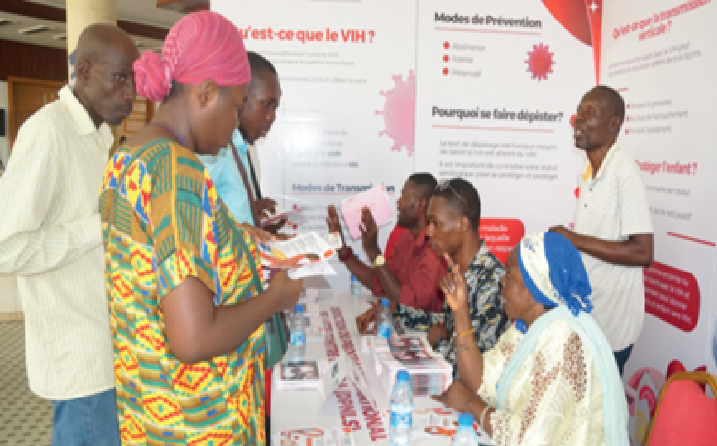
The fight against HIV/AIDS in Congo-Brazzaville has
reached a significant milestone with the inauguration of the new headquarters
of the National AIDS Control Program (PNLS), officially opened in Brazzaville
in December 2025 by the Minister of Health, Professor Jean-Rosaire IBARA. This
modern facility was renovated with support from the United Nations Development
Programme (UNDP), funded by the Global Fund to Fight AIDS, Tuberculosis and
Malaria.
Located in Poto-Poto in the heart of a popular area
of the 3rd arrondissement of Brazzaville (Mfoa district), the new building
includes 23 functional spaces designed to improve the working conditions of the
teams responsible for coordinating the national response against HIV.
The building was designed according to modern
environmental standards and is part of a broader program to strengthen the
Congolese health system. Beyond its administrative function, this new
headquarters symbolizes the renewed commitment of the Congo and its partners to
the fight against HIV/AIDS. At the handover ceremony, UNDP officials expressed
their hope that this location would become a true coordination center for
prevention, testing, patient care, and monitoring of international objectives
to combat the epidemic.
This modernization comes at a strategic time as
Congo continues its efforts to improve access to antiretroviral treatments,
strengthen testing and achieve global goals to end AIDS as a public health
threat by 2030. "This new headquarters must be a beacon of hope in the
prevention, testing and treatment of HIV," said Ms. Adama-Dian Barry, UNDP
Resident Representative in Congo.
For health authorities, this infrastructure goes far
beyond a simple administrative space. It embodies the commitment to modernizing
coordination tools, improving working conditions for technical teams, and
strengthening the effectiveness of interventions in the field. “This building
is not just a set of offices. It is an investment in the future of public
health in Congo and in the quality of the national response to HIV/AIDS,”
emphasized the UNDP Resident Representative in Congo, Adama-Dian Barry, during
the official handover ceremony.
A
STRATEGIC TOOL FOR ACHIEVING THE 2030 GOALS
At a time when the international community has set
itself the goal of ending AIDS as a public health threat by 2030, the leaders
of the PNLS see this new headquarters as a strategic lever to accelerate
prevention, screening and treatment efforts and to bring services closer to the
population.
The building now houses the various units
responsible for coordinating national HIV programs, monitoring epidemiological
indicators, and working with technical and financial partners. “We now have a
workspace adapted to our missions. This will improve the coordination of
activities and provide better conditions for the teams who are engaged daily in
the fight against HIV,” stated the director of the National AIDS Control
Program (PNLS). This modernization comes as the Congo continues its efforts to
improve access to antiretroviral treatment, strengthen early detection, and
reduce new infections.
The vision for 2030:
ending AIDS as a public health threat in Congo will require acceleration screening, strengthening
combined prevention, reducing inequalities, continuing the integration of HIV
services into primary health care, maintaining and sustaining achievements.
A
SIGNAL OF HOPE FOR THE PEOPLE LIVING WITH HIV
For organizations working with people living with
HIV, this new infrastructure also brings hope. It demonstrates a renewed
commitment from public authorities and international partners to maintain HIV
as a national health priority.
While therapeutic advances now allow patients to
live longer and in better conditions, many challenges remain: combating stigma,
ensuring equitable access to care, supporting vulnerable populations, and
securing sustainable funding. "The fight against AIDS is not won solely in
hospitals or laboratories."
"It is also won through strong institutions,
capable of coordinating actions and supporting the most exposed
populations," recalled a civil society actor involved in the national
response.
THE
SYMBOL OF A STRUGGLE WHO CHANGES FACE
The inauguration of the new PNLS headquarters comes
at a pivotal moment in the history of HIV in Congo. Long associated with fear
and inevitability, the disease has now become a chronic condition whose control
is made possible by scientific advances. In this context, this new building
symbolizes an evolving fight: a fight that is no longer limited to responding
to the health emergency, but is now part of a long-term vision based on
prevention, innovation, and hope. “This headquarters must become a beacon for
HIV prevention, testing, and care in Congo.”
“It represents our collective commitment to leave no
one behind in the fight against the epidemic,” said Adama-Dian Barry. Through
this achievement, Congo-Brazzaville sends a clear message: despite the
remaining challenges, the HIV response continues to strengthen, driven by
better-equipped institutions and a renewed ambition to build a generation free
from AIDS.
No comments for the moment