BIOMEDICAL WASTE MANAGEMENT A BIG CLEAN-UP ON WASTE BIOMEDICALS IN CONGO!
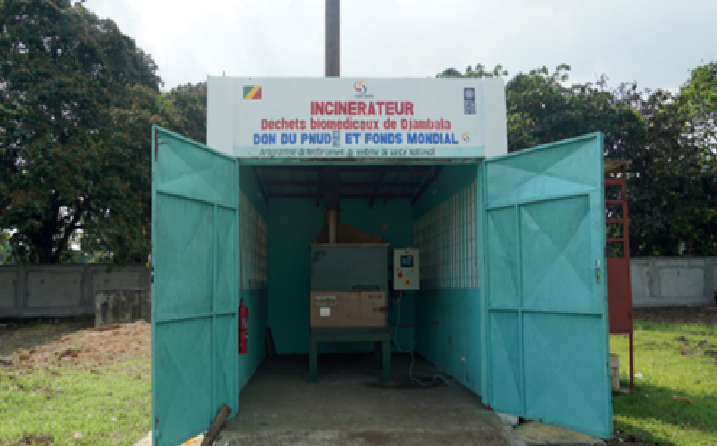
Thanks to a strategic partnership between the Ministry of
Health and Population, the United Nations Development Programme (UNDP), and the
Global Fund, the Republic of Congo is taking a decisive step forward in
biomedical waste management. The country is equipping itself with high-tech
incinerators designed to safely dispose of this waste. In total, twelve
hospitals across seven departments will be equipped with modern facilities
ensuring the safe treatment of biomedical waste.
In Brazzaville, four of the country's largest healthcare
facilities have officially received their new incinerators, putting an end to
the recurring breakdowns that had hampered their operation. The first
recipients are the Brazzaville University Hospital Center (CHU-B), the
Blanche-Gomes Mother and Child Specialized Hospital, the National Public Health
Laboratory (LNSP), and the Pierre-Mobengo Central Military Hospital. In
Pointe-Noire, the Loandjili and Adolphe-Sicé hospitals have also been equipped.
The rollout continues in Oyo and Owando (Cuvette), Djambala (Plateaux),
Impfondo (Likouala), and Ouesso (Sangha).
STATE-OF-THE-ART
EQUIPMENT ADAPTED TO NEEDS
To carry out this modernization, the South African
company Macrotec was selected. Its involvement went beyond simply supplying
equipment: it also oversaw the construction of secure ash pits and the
installation of 2,500-liter storage tanks at each site. The incinerators were
sized according to the specific needs of each facility. The high-capacity V50
models were installed at the CHU-B and Blanche-Gomes hospitals to process large
volumes of waste. The more compact V32 models meet the needs of the LNSP and
the Pierre-Mobengo Military Hospital.
A
RELIEF FOR THE HEALTHCARE FACILITIES
“We can only welcome this gesture. We sincerely
thank the Minister of Health and Population, who worked to ensure these
incinerators were made available to us as quickly as possible to address our
shortcomings. We pledge to make excellent use of them,” declared Professor Roch
Flabien Niama, Director General of the National Public Health Laboratory. At
the Blanche-Gomes Mother-Child Specialized Hospital, the Director of Logistics
and Facilities, Éric Moka, also expressed his appreciation for the support of
the Global Fund and the Ministry of Health.
Until now, the facility had to process not only its
own biomedical waste, but also that of the Brazzaville University Hospital. At
the Pierre-Mobengo Central Military Hospital, the chief medical officer,
Colonel-Major Jean Bertin Illoye, emphasized that this new facility will allow
the incineration activity to resume, as the old equipment had been out of
service for several months.
A
DYNAMIC NATIONAL DEMANDED TO EXPAND
The Director of Hygiene and Health Promotion, Dr.
Jean-Claude Emeka, welcomed the fact that these four facilities have become
self-sufficient in the treatment of their biomedical waste. He specified,
however, that this equipment could also be used by other healthcare facilities
if needed. “In total, twelve incinerators have been acquired. The users have
been trained, and the commissioning phase is now complete.”
On behalf of the Minister of Health and Population,
who has made this a priority, we warmly thank the Global Fund and UNDP for the
success of this project. We now hope that the management of biomedical waste
will be fully secure and that this momentum will quickly spread to other
departments,” stated Dr. Jean-Claude Emeka. For Hugues Traoré, UNDP Project
Coordinator for the Global Fund, this donation represents a major step forward.
“UNDP and the Global Fund are proud to have supported the Ministry of Health
and Population in implementing this project. We are convinced that it will
relieve the burden on hospital teams and sustainably strengthen their technical
capacities. It is a real pleasure to hand over this equipment to the
beneficiary facilities,” he declared, before urging hospital administrators to
use it responsibly.
WHY
A SUCH AN EMERGENCY?
The management of biomedical waste—syringes,
needles, gauze, cotton, contaminated tissues, and anatomical waste—remains a
major challenge in Africa, particularly in the Republic of Congo. According to
the World Health Organization (WHO), nearly 85% of the waste produced by
healthcare facilities is harmless. However, the remaining 15% presents
infectious, chemical, or radioactive risks and requires specific treatment.
When this waste is improperly disposed of, it facilitates the transmission of
serious infections such as HIV and hepatitis B and C, while also increasing the
risk of hospital-acquired infections in both patients and healthcare
professionals. Open burning or uncontrolled dumping also leads to air, soil,
and groundwater pollution, with significant consequences for local communities.
The steady increase in healthcare activities,
vaccination campaigns, and medical interventions leads to a growing volume of
biomedical waste produced each year. However, many facilities still lack
sorting, collection, and treatment equipment that meets international
standards. It is in this context that the support of UNDP and the Global Fund
to the Ministry of Health becomes crucial. By equipping a dozen hospitals with
modern incinerators, these partners are contributing to a lasting strengthening
of health security, protecting healthcare professionals, patients, and the
environment, while simultaneously improving the overall quality of the
Congolese healthcare system.
No comments for the moment