FACING CLIMATE CRISES: CONGO STRENGTHENS ITS RESILIENCE STRATEGY WITH UNDP SUPPORT
Thanks to a strategic partnership between the Ministry of
Health and Population, the United Nations Development Programme (UNDP), and the
Global Fund, the Republic of Congo is taking a decisive step forward in the
management of biomedical waste. The country is equipping itself with high-tech
incinerators designed to safely dispose of this waste.
In total, twelve hospitals across seven departments will
be equipped with modern equipment ensuring the safe treatment of biomedical
waste. In Brazzaville, four of the largest healthcare facilities have
officially received their new incinerators, thus ending the repeated breakdowns
that had compromised their operation.
The first beneficiaries are the Brazzaville University
Hospital Center (CHU-B), the Blanche-Gomes Mother and Child Specialized
Hospital, the National Public Health Laboratory (LNSP), and the Pierre-Mobengo
Central Military Hospital. In Pointe-Noire, the Loandjili and Adolphe-Sicé
hospitals have also been equipped. Deployment continues in Oyo and Owando
(Cuvette), Djambala (Plateaux), Impfondo (Likouala), and Ouesso (Sangha).
Brazzaville has just adopted an
ambitious roadmap for 2030 to anticipate and manage the effects of climate
change. This is a crucial investment for the country's socioeconomic future.
Anticipating rather than reacting: this is the whole point of the United
Nations Programme's action.
United Nations Development
Programme (UNDP), which supports developing countries towards an integrated
risk culture. In Congo-Brazzaville, this commitment has materialized in a
historic milestone: the adoption of the National Strategy for Disaster Risk Prevention
and Management (SNPGRC) for 2030. The result of 24 months of intensive work and
in-depth exchanges between national experts, public administrations and
international partners, this large-scale project required the mobilization of
nearly 22 billion CFA francs by the UNDP.
A
SHIELD ALIGNED WITH THE NATIONAL AMBITIONS
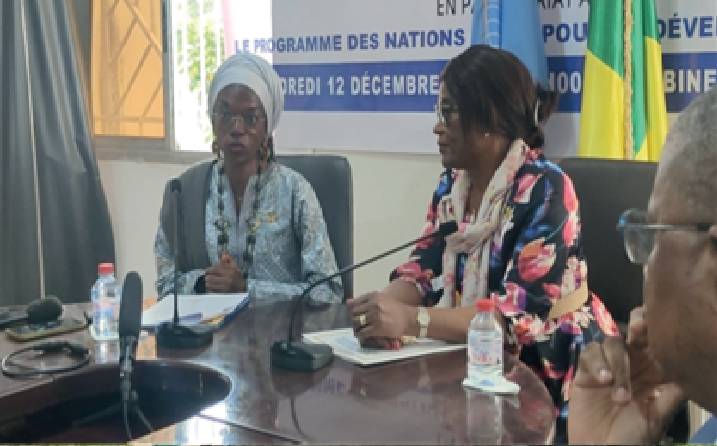
Officially presented on December 12, 2025 in
Brazzaville, this strategic document fits perfectly into the National
Development Plan (PND 2022-2026). The objective is clear: to protect the
Congolese economy and infrastructure against the onslaught of climate change
and recurring major crises.
The aim is to minimize human losses, preserve
material goods and safeguard the country’s social and environmental services.
To guide this ambition, the Congo is relying on
inclusive governance through a dedicated national platform. This structure, a
true control center, brings together an inter-ministerial committee, local
authorities, civil society, and the private sector. “The National Strategy for
Risk and Disaster Management (SNPGRC) is structured around four major
priorities: understanding risks, strengthening governance, investing in
resilience, and improving disaster preparedness and response,” stated Narcisse
Ofoulou, Director of Ecology and Natural Resources. This strategy thus paves
the way towards the UN’s “Vision 2050,” which advocates for harmonious
coexistence with nature to curb biodiversity loss.
MULTILATERALISM
AT SUSTAINABLE DEVELOPMENT DEPARTMENT
The UNDP Resident Representative in Congo, Adama
Dian Barry, commended Congo-Brazzaville for its leadership in upholding its
international commitments. According to her, this strategy and its tools form
"the foundation upon which vital actions for the rational and sustainable
economic development of the country can be firmly established." She also
emphasized the strength of the partnership.
Congo-UNDP demonstrates the country's unwavering
commitment to multilateralism to build a common green future.
BIODIVERSITY:
CONGO'S NEW GREEN GOLD
Demonstrating the convergence of environmental
struggles, this event also coincided with the launch of the National Action
Plan for Biodiversity 2025-2030. For Arlette Soudan-Nonault, Minister of the
Environment, Sustainable Development, and the Congo Basin, protecting life goes
far beyond mere environmental ethics. It is a major economic imperative:
biodiversity is now at the heart of the country's strategic value chains, such
as the timber, agriculture, water management, fishing, and ecotourism sectors. With
these new tools, Congo is positioning itself more than ever as a key player in
the ecological transition in Central Africa.
No comments for the moment