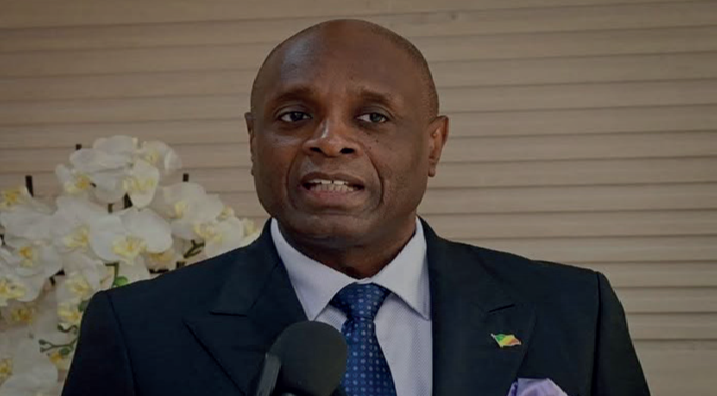
CONSTANT-SERGE BOUNDA AT THE HEAD OF CONGOLESE DIPLOMACY: THE BET ON EXPERIENCE
The
new government formed following the president's inauguration
Denis
Sassou N’Guesso is pursuing a strategy of institutional continuity, exemplified
by the retention of Anatole Collinet Makosso as head of government. However,
within this new team, one appointment has particularly caught the attention of
observers: that of Serge Bounda as Minister of Foreign Affairs, Francophonie,
and Congolese Abroad. A career diplomat renowned for his expertise in
international relations, Serge Bounda inherits a strategic portfolio at a time
when global power dynamics are shifting and Africa is playing an increasingly
central role in economic, diplomatic, and security rivalries.
A MAN OF THE FIELD COURSE INTERNATIONAL
Far from being a new figure in diplomatic circles,
Serge Bounda has built a reputation over the years as a man of dialogue and
negotiation. His career within the Congolese administration, enriched by
several responsibilities held within the United Nations system and during
international missions, has allowed him to acquire a solid understanding of the
mechanisms of multilateral cooperation.
This experience is now one of his main strengths.
Accustomed to major international negotiations, he understands the sometimes
complex balances that govern relations between states and is familiar with the
expectations of both bilateral partners and major international institutions.
His appointment thus reflects the Congolese authorities' desire to place at the
head of their diplomacy a professional capable of defending the country's
interests with method, credibility, and pragmatism.
GIVE IT A NEW LEASE OF LIFE TO
FOREIGN POLICY
The challenge facing the new minister extends far
beyond mere protocol. In an international context marked by a proliferation of
crises, geopolitical tensions, and increasing competition among powers for
influence on the African continent, the Republic of Congo seeks to strengthen
its diplomatic visibility. The ambition is clear: to consolidate relations with
historical partners while diversifying economic and political alliances.
Congolese diplomacy must also support national priorities in investment,
sustainable development, and international cooperation. This approach implies
strengthening Congo's presence within major multilateral forums, particularly
the United Nations, the African Union, the Economic Community of Central
African States (ECCAS), and the Central African Economic and Monetary Community
(CEMAC)..
MAKING DIPLOMACY A DEVELOPMENT
LEVER
Beyond its traditional missions of representing the
state and conducting political relations with foreign partners, Congolese
diplomacy is called upon to play a much more active role in the country's
economic development. The authorities now wish to transform embassies and
diplomatic missions into genuine instruments for promoting national economic
interests, capable of attracting investment, facilitating trade, and opening
new markets for Congolese businesses.
In this context, the Ministry of Foreign Affairs
will need to work closely with the departments responsible for the economy,
finance, trade, industry, and hydrocarbons to better promote Congo's strengths
to international investors. The country possesses significant natural
resources, largely untapped agricultural potential, a strategic geographic
location in the heart of Central Africa, and port infrastructure that can be
compelling arguments for attracting economic partners.
The challenge facing the new
minister goes far beyond the realm of protocol relations.
Economic diversification is also among the
priorities. In a context where many oil-producing countries are seeking to
reduce their dependence on hydrocarbon revenues, economic diplomacy will need
to help promote promising sectors such as agriculture, manufacturing, mining,
renewable energy, tourism, the digital economy, and services.
The objective is to promote partnerships that create
added value, to stimulate productive investments and to support job creation.
This strategy also implies a diplomacy more focused
on innovation and major international issues.
The energy transition, the fight against climate
change, the preservation of the forests of the Congo Basin, the financing of
sustainable development, and scientific and academic cooperation are all areas
in which the Congo intends to strengthen its presence and develop mutually
beneficial partnerships.
Another major undertaking is mobilizing the
Congolese diaspora. Present in Africa, Europe, North America, and several other
regions of the world, Congolese living abroad represent a significant pool of
skills, professional experience, and economic networks. Beyond the financial
transfers they send to their families each year, they can play a crucial role
in attracting investment, transferring technology, fostering entrepreneurship,
promoting innovation, and enhancing the country's international standing.
In this context, Congolese diplomacy is called upon
to strengthen dialogue with the diaspora, create mechanisms to encourage its
involvement in national projects, and develop incentive programs enabling
Congolese entrepreneurs, researchers, and professionals living abroad to
contribute more effectively to the country's economic and social development.
For Serge Bounda, this challenge lies in transforming the image of Congolese
diplomacy: from an administration primarily focused on political and protocol
relations, it must gradually become a development actor, capable of supporting
Congo's economic ambitions and positioning the country as a credible and
attractive partner on the international stage.
The regional context remains
one of the new minister's main issues.
CENTRAL AFRICA CORE
PRIORITIES
The regional context remains one of the new
minister's main priorities. Central Africa continues to face numerous security,
humanitarian, and political challenges that necessitate strengthened
cooperation among states. Traditionally committed to dialogue and mediation,
the Republic of Congo intends to pursue its commitment to regional stability.
This mission will require proactive diplomacy, capable of combining conflict
prevention, security cooperation, and the promotion of regional integration. In
this area, Serge Bounda's international experience could be a significant asset
in reinforcing Brazzaville's role as a key player in Central Africa.
Beyond political
considerations, this appointment is part of a broader desire to modernize the
Ministry of Foreign Affairs.
UPGRADE THE DEVICE DIPLOMATIC
Beyond political considerations, this appointment
reflects a broader desire to modernize the Ministry of Foreign Affairs. The
stated objective is to develop a more results-oriented diplomacy, more
responsive and better adapted to new international challenges. This evolution
involves, in particular, increased use of digital tools, more effective
institutional communication, and a strengthening of economic diplomacy. Faced
with the challenges related to climate change, food security, biodiversity, and
the energy transition, the Congo also intends to amplify its voice in major
international debates.
P O L I T I Q U E
A RESPONSIBILITY THAT MATTERS OF THE AMBITIONS
By entrusting the reins of his diplomacy to Serge
Bounda, President Denis Sassou N'Guesso has opted for experience and continuity
in a particularly demanding international environment. The new minister
possesses a solid understanding of multilateral institutions and international
cooperation mechanisms. The challenge now is to translate this expertise into
tangible results. At a time when diplomacy has become a major instrument of
influence, economic attractiveness, and the defense of national interests,
Serge Bounda will have to demonstrate his ability to advance Congo's ambitions
on the international stage and to sustainably integrate the country's foreign
policy into a dynamic of openness, cooperation, and development.
No comments for the moment