CHOLERA IN CONGO-BRAZZAVILLE:THE HEALTH EMERGENCY, REVEALING PUBLIC HEALTH CHALLENGES
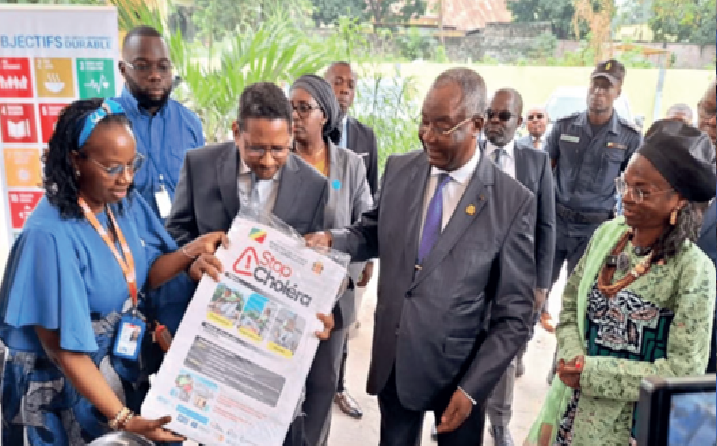
Since the end of July 2025, the Republic of Congo has
been facing a resurgence of cholera, severely straining its healthcare system.
While the first wave of the epidemic appeared to be contained following a rapid
mobilization of authorities and international partners, the disease continued
to spread in the following months, highlighting that cholera remains a key
indicator of inequalities in access to safe drinking water, sanitation, and
healthcare. Beyond the statistics, this epidemic underscores the persistent
structural weaknesses in several regions of the country and highlights the
urgent need to sustainably strengthen national prevention and response
capacities.
AN
EPIDEMIC THAT HAS INSTALLED FOR THE LONG TERM
Officially declared on July 26, 2025, the epidemic
had recorded 434 confirmed cases and 34 deaths a few weeks later. The first
outbreaks were mainly on Mbamou Island, in the Talangaï district of
Brazzaville, and along the Mossaka-Loukoléla axis, areas where access to
drinking water, sanitation infrastructure, and healthcare remains particularly
limited.
Nearly a year later, the health situation remains
concerning. As of June 14, 2026, the country had recorded 1,531 cases of
cholera and 127 deaths, spread across six departments, reflecting the
geographic expansion of the epidemic. The Likouala department is now among the
main centers of transmission with 316 cases, representing 20.6% of the cases
recorded nationally. Its case fatality rate, estimated at 10.1%, testifies to
the severity of the situation in this isolated region. Cholera remains a
preventable and curable disease. Yet, when it occurs in areas where essential
services are lacking, it continues to cause preventable deaths and to
permanently weaken populations.
A
MOBILIZATION NATIONAL AND INTERNATIONAL
Every barrel of clean water, every awareness
campaign, every hygiene practice saves lives.
From the first reports, Congolese authorities
launched a response with the support of the United Nations system and several
technical and financial partners. The United Nations Population Fund (UNFPA)
strengthened community awareness activities to encourage the adoption of
essential hygiene measures. “Informing the population, promoting good hygiene
practices, and strengthening community mobilization are absolute priorities,”
reiterated Agnès Kayitankore, UNFPA Resident Representative.
The World Health Organization (WHO) activated its
incident management system as soon as the outbreak was officially declared.
Among the first actions taken were: the delivery of seven tons of medicines and
cholera kits; the establishment of treatment centers in Mbamou, Mossaka, and
Talangaï; the training of 172 healthcare professionals and 250 community health
workers; the disinfection of dozens of wells and health facilities; and the
provision of logistical support to reach the most remote areas. This initial
response phase helped limit the spread of the disease while preparing health
facilities to cope with a longer-term crisis.
Cholera is not inevitable. It remains a
revealer of persistent inequalities, but can also become a lever for
transformation.
OVER
$100,000 TO STRENGTHEN THE RESPONSE
On August 11, 2025, the United Nations Development
Programme (UNDP), with funding from the Global Fund, delivered a significant
shipment of prevention equipment worth over US$101,000 to the Ministry of
Health and Population. This assistance included 14,000 items of sanitation and
hygiene equipment: sprayers, jerrycans, bleach, boots, protective gloves,
garbage bags, buckets, and various other materials designed to limit the spread
of Vibrio cholerae, the bacterium that causes cholera. This intervention was
part of a coordinated effort with the WHO, UNICEF, UNFPA, and the entire United
Nations system.
LIKOUALA,
NEW EPICENTER OF THE RESPONSE
Today, one of the main challenges lies in the
Likouala department, where many localities remain accessible only by river. In
Mombenzele, travel is primarily by dugout canoe on the Ubangi River. This
isolation significantly complicates access to healthcare, drinking water, and
sanitation facilities. In response to this situation, the Ministry of Health,
with support from the WHO, has strengthened healthcare capacity in several
health districts.
One of the major advances was the creation of a
Cholera Treatment Unit (CTU) in Mombenzele. Compliant with international
standards, this facility now ensures rapid and safe patient care while limiting
the risk of transmission within communities.
Because fighting cholera is not just about interrupting
a chain of transmission: it is about building a more equitable, more resilient
health system that is better prepared for the health challenges of tomorrow.
THE
INITIAL RESULTS APPEAR ENCOURAGING.
Between May 31 and June 14, 2026, while the number
of cases in Likouala increased from 259 to 316, the number of deaths rose by
only three, resulting in a decrease in the case fatality rate from 11.2% to
10.1%. In the Impfondo health district, no deaths were recorded among the new
cases reported during this period, suggesting that earlier intervention
significantly reduces cholera-related mortality. Simultaneously, the WHO
ensured the regular supply of essential medicines, medical equipment, and
consumables to health facilities for patient care.
BEYOND
THE EMERGENCY, STRENGTHENING THE HEALTH SYSTEM SUSTAINABLY
This crisis serves as a reminder that cholera is not
just an infectious disease. It is also a symptom of deep social and territorial
inequalities. Each outbreak reveals the same weaknesses: insufficient access to
clean water, inadequate sanitation systems, limited health infrastructure, and
difficulties accessing healthcare in rural, island, and forested areas.
Emergency measures—treatment centers, disinfection
of water sources, epidemiological surveillance, awareness campaigns, and
distribution of preventative materials—remain essential. However, they cannot
produce lasting effects without massive investments in water infrastructure,
sanitation, human resources in healthcare, and surveillance systems.
MAKING
CHOLERA A CATALYST FOR REFORMS
The current epidemic is a true test for the Republic
of Congo's public health policy. Every well drilled for clean water, every
strengthened health center, every trained community health worker, and every
awareness campaign represents an investment in national health security.
Cholera is not inevitable.
It remains a stark reminder of persistent
inequalities, but it can also become a catalyst for transformation. Turning
this crisis into an opportunity requires sustained investment in prevention,
improving universal access to clean water and sanitation, strengthening
emergency response capacities, and bringing health services closer to the most
isolated populations. Because fighting cholera is not just about breaking a
chain of transmission: it's about building a more equitable, more resilient
health system, better prepared for the health challenges of tomorrow.
No comments for the moment