A HOMMAGE TO NELSON MANDELA : "ASIMBONANGA" BY JOHNNY CLEGG & SAVUKA
ASIMBONANGA : This column, inspired by RFI,
aims to tell the big story through popular songs that have become collective
touchstones.
Each
episode begins with a piece of music to reveal what it tells us about a
historical event, an era, or a social and cultural phenomenon. With
"Asimbonanga," a song gave a face back to a man whom the regime
wanted to render invisible. This song became one of the international anthems
of the struggle against apartheid and helped make Nelson Mandela a global
symbol of that fight.
It is
the summer of 1986 in South Africa. The apartheid regime has declared a state
of emergency. Demonstrations against racial segregation are multiplying and are
being violently repressed. The same figure looms large in everyone's minds:
that of Nelson Mandela, imprisoned for twenty-four years. His name is known to
all, but his face has been erased from the public sphere. The authorities
forbid the dissemination of his photographs. Entire generations thus grow up
without ever having seen his face. This is also the case for Johnny Clegg, a
white singer who grew up surrounded by Zulu musicians.
“We had
never seen Mandela, yet for us, the mere sound of his name evoked the promise
of a new South Africa,” he would later confide. At the age of 33, he composed
“Asimbonanga,” which means “The One We Have Not Seen” in Zulu. The song was
released in 1987.
Everything
in this work constitutes a challenge to the apartheid regime. First, its title,
then the choice to openly pronounce Mandela's name, at a time when many artists
preferred to use pseudonyms to circumvent censorship. Next, the band Savuka,
which, exceptionally for the time, brought together Black and white musicians.
Finally, the choice of languages: verses in English and choruses in Zulu.
Where
apartheid divided, Johnny Clegg united, much like Mandela. The lyrics also drew
inspiration from the imprisoned leader's thinking, particularly his famous
speech at the Rivonia Trial, just before his life sentence. "Who will find
the words to abolish the distance between you and me?" sings Johnny Clegg.
Unsurprisingly, "Asimbonanga" was banned in South Africa. But the
song crossed borders, circled the globe, and helped strengthen the
international movement against apartheid, thus contributing to the regime's
inexorable decline.
On
February 11, 1990, the world finally saw the radiant face of Nelson Mandela,
released at the age of 71 after twenty-seven years of imprisonment. In 2010,
Johnny Clegg recalled that moment on RFI: “It was fantastic. For me, it was as
if the clouds had parted to reveal paradise.” Could he have imagined that one
day Madiba, who had become South Africa’s first democratically elected Black
president, would give him the greatest gift of his career?
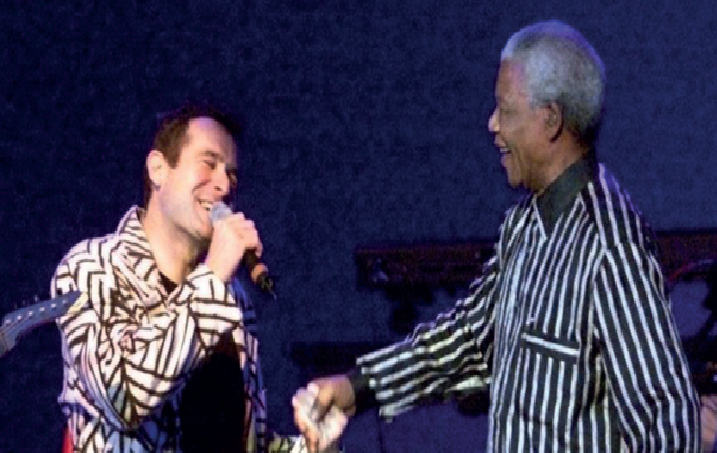
In the
spring of 1997, during a concert in Frankfurt, Germany, while Johnny Clegg was
performing "Asimbonanga," Nelson Mandela unexpectedly joined him on
stage. Moved like a child before his hero, the singer handed him the
microphone. Mandela then addressed the audience: "It is music and dance
that bring me peace with the world and with myself. Besides, I haven't seen you
dancing much. Shall we start again?" Johnny Clegg immediately launched
into the song.
Beside
him, Nelson Mandela began to dance, his face lit by a radiant smile. This scene
will remain one of the most moving in the history of protest music, as a symbol
of a song that had contributed, long before freedom was regained, to making
visible the man whom an entire regime wanted to erase.
No comments for the moment